
Every market needs someone who is always there. On Earth, that someone is a market maker: a trader who keeps buy and sell quotes standing, so that anyone who wants to trade finds a counterparty right away. Market makers earn the spread between their prices and carry the risk of holding inventory. Without them, markets go quiet.
A Martian settlement will need the same thing. A colonist who earns bitcoin from an Earth employer will want marscoin to spend at the habitat. A supplier on Earth will want to be paid. And here is the problem: the market maker can't sit on an exchange, because there is no exchange both planets can use.
This article explains how a market maker works when the exchange is not a company but a protocol. It also introduces the first one, which went live on Marscoin this week.
Why an Exchange Can't Span Two Planets
An exchange is a place where both sides send their money first. The exchange holds it, matches orders, and pays out. That works on Earth because the round trip to the exchange takes milliseconds and the exchange is, mostly, trustworthy.
Between Earth and Mars, light takes 3 to 22 minutes each way. About every 26 months the Sun sits between the planets and blocks radio contact for roughly two weeks. An exchange on Earth would be holding a Martian's money with no way for the Martian to reach it, check on it, or get it back quickly. An exchange on Mars would have the same problem in reverse. As the DeFi on Mars article argues, every custodial design breaks at the physical layer.
The requirement: two people on two worlds must be able to trade without either of them, or anyone in between, ever holding the other's money.
The Exchange Is the Protocol
The answer has existed since 2013. It is called an atomic swap, and it is built from hash time-locked contracts: lockboxes on each blockchain that open with the same secret.
Here is a swap of marscoin for bitcoin, step by step:
- The seller locks the MARS in a lockbox on the Marscoin blockchain. Only the buyer can open it, and only with a secret the seller knows. If nothing happens, the seller can take it back after about eight hours.
- The buyer checks that lock on the Marscoin blockchain, then locks the bitcoin in a matching lockbox on the Bitcoin blockchain. The seller can open it with the same secret. If nothing happens, the buyer can take it back after about four hours.
- The seller opens the bitcoin lockbox, and to do so must publish the secret on the Bitcoin blockchain.
- The buyer reads the secret from the Bitcoin blockchain and opens the MARS lockbox.
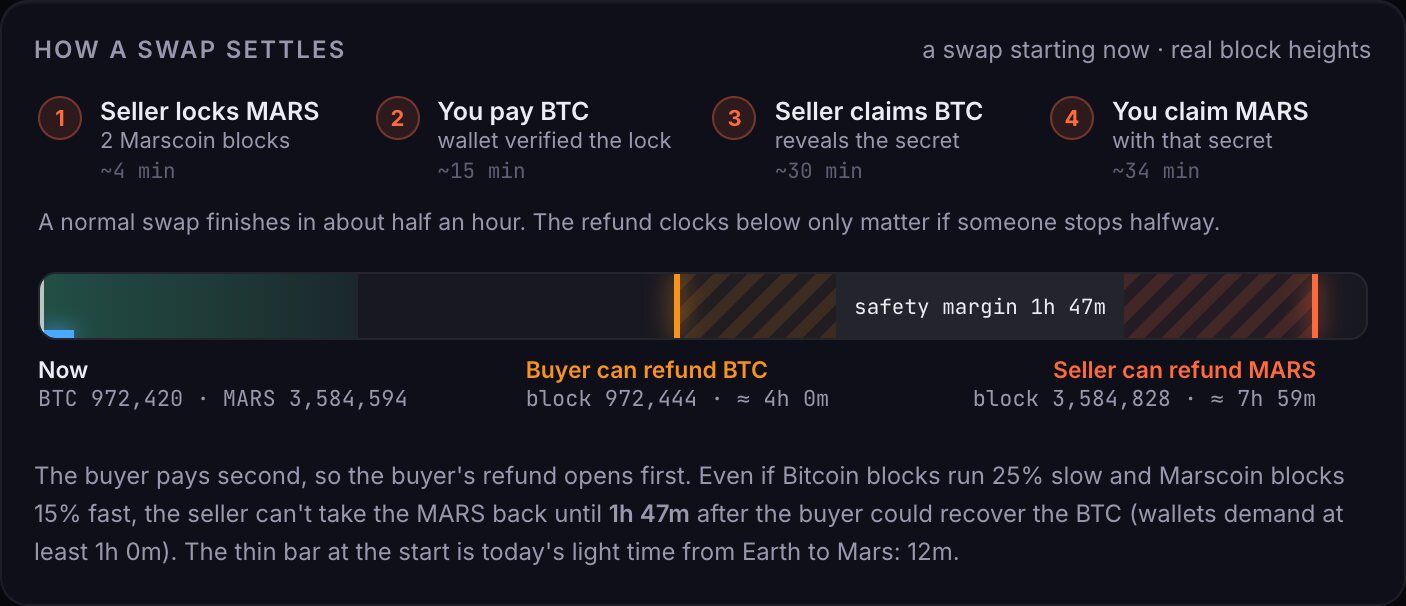
Either both lockboxes open or neither does. Nobody holds anyone's coins in between. The buyer's refund opens before the seller's, because the buyer pays second. That way the seller can never take back the MARS while also holding the bitcoin.
What is left of "the exchange" is just a bulletin board: an order book where sellers post offers. In Marscoin's case it is relayed by the network's ElectrumX servers. Anyone can post an offer, anyone can take one, and the board itself never touches money.
The First Maker Is Live
An open order book still needs someone to fill it. This week the Marscoin Foundation started an always-on market maker that sells MARS for bitcoin through atomic swaps, with a public dashboard at swaps.marscoin.org.
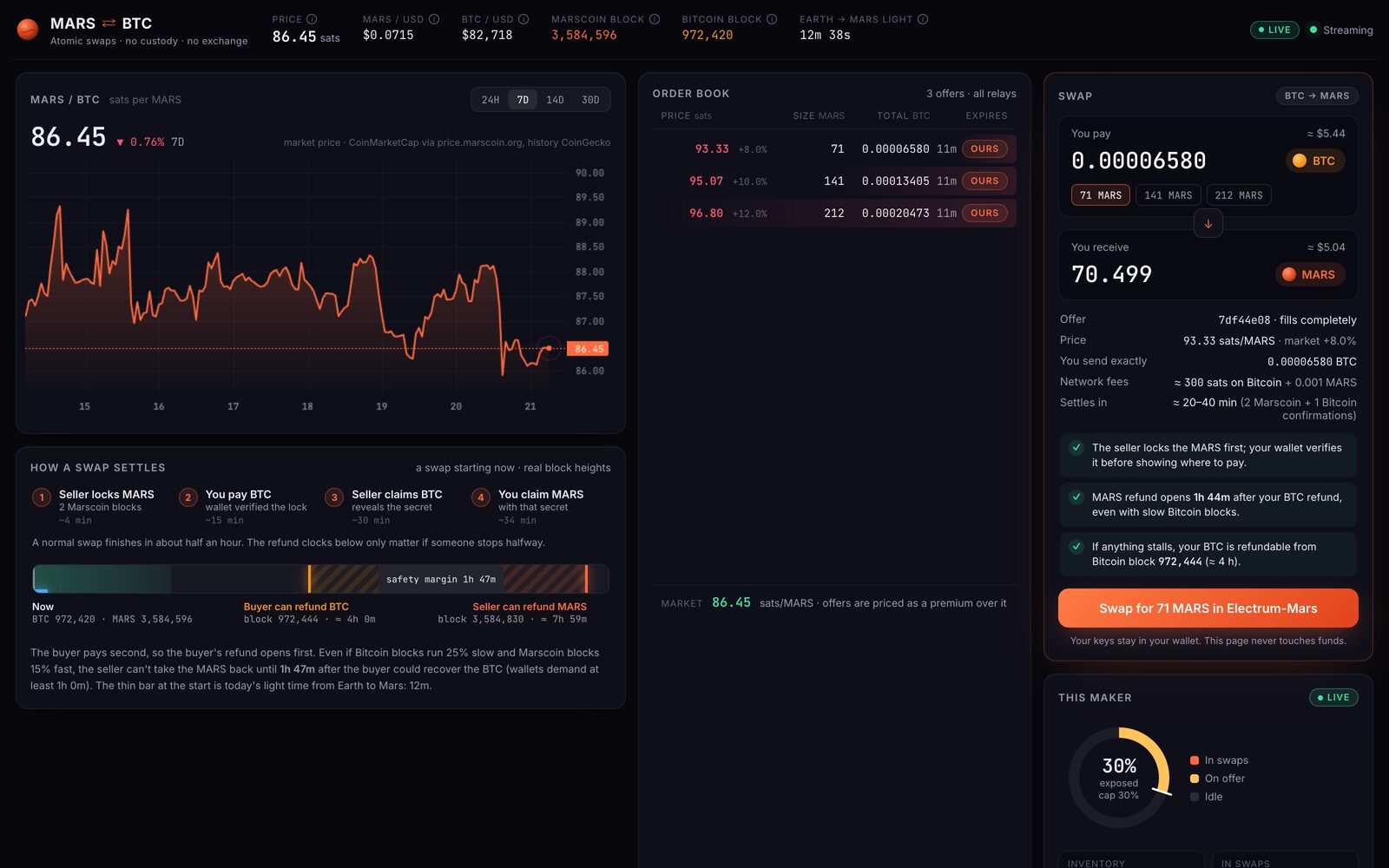
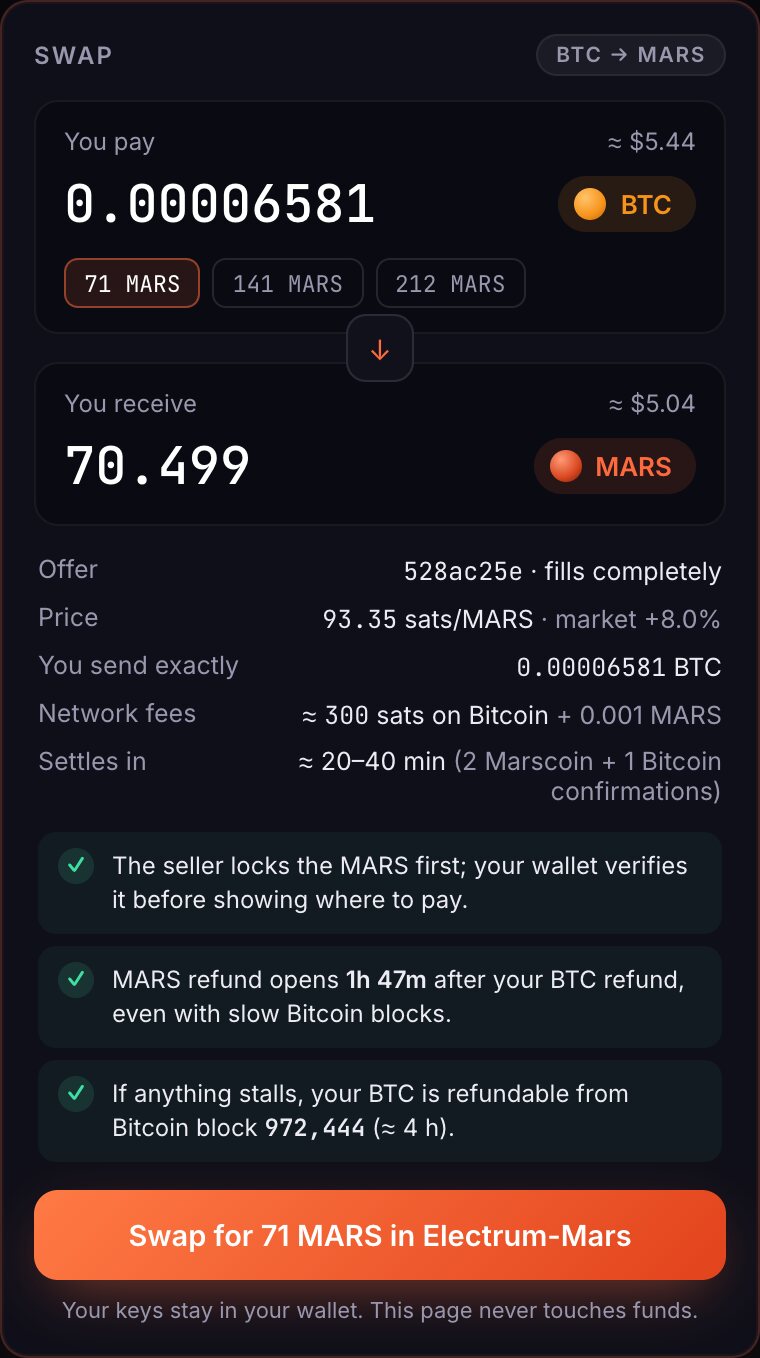
The dashboard shows every offer from every relay server. For each one it checks the same thing a buyer's wallet checks before paying: whether the seller's refund opens safely after the buyer's. Pick an offer and it shows exactly what you would pay and receive, and the guarantees behind the trade:
The Rules a Maker Lives By
An honest maker can't be cheated out of its coins by an atomic swap. It can, however, be harassed. Someone can accept an offer and never pay. The maker's MARS then sits locked until the refund opens, eight hours later. Do that to every offer and the maker is frozen. The first maker follows four rules, and each is worth understanding:
- Exposure cap. MARS locked in swaps plus MARS on offer never exceeds 30% of inventory. Even if every offer were taken by a griefer at once, most of the inventory stays free.
- One swap per buyer. Relay servers with the new abuse controls tag each connection with an anonymous fingerprint. A buyer with a swap in progress can't take a second one. The maker reports buyers who abandon swaps, and those relays block them for a day.
- No guessed prices. Offers are priced at a spread over the live market. If the price feed is stale, the maker posts nothing rather than risk a wrong price.
- No late claims. The maker won't open the bitcoin lockbox when the buyer's refund is minutes away. Publishing the secret that late could let a buyer refund the bitcoin and claim the MARS too. Too close to the deadline, the maker lets the swap unwind instead.
From Earth Hours to Martian Days
Today's swaps use refund windows of four and eight hours. That's generous for two parties on Earth, where a swap normally finishes in about half an hour. The dashboard's timeline shows both clocks with real block heights. Even in the worst case, the seller can't reclaim the MARS until well after the buyer could recover the bitcoin.
Nothing in this protocol depends on the parties being close. The secret is just as valid on Mars as on Earth. The only thing that changes across planets is how long the lockboxes must stay open. The InterPlanetary Atomic Swaps paper sizes them:
- At average distance (about 13 light-minutes): 72 hours for bitcoin and 144 hours for MARS.
- At greatest distance (about 22 light-minutes): 96 and 192 hours.
- Across a solar conjunction: 21 days and 28 days, so a swap can survive two weeks without radio contact.
That changes the economics of market making. A Martian maker's coins may be locked for days, or weeks around conjunction, instead of hours. Spreads will price that time, the way interest prices a loan. It's the same lesson as the bills of exchange that financed trade across oceans centuries ago, with light instead of sailing ships.
Anyone Can Be a Maker
The first maker has no special status. The program it runs, atomicswapd, is open source. It uses the same swap engine as the Electrum-Mars wallet and runs on any small server. A few commands on fly.io get one running for about six dollars a month. The repository even includes instructions an AI assistant can follow to set one up, without ever seeing the wallet's secret seed. More makers mean tighter spreads and a market that doesn't depend on anyone.
On Mars, the first maker might be a small computer in a habitat's server rack, running the same software from a bootable image brought on the first ship, quoting prices to the colony and settling with Earth across the light delay.
Markets were never really about exchanges. They are about trust: knowing that if you hand over what you owe, you will get what you are owed. For most of history that trust came from institutions close enough to hold you to account. Between planets nothing is close enough. Atomic swaps replace that trust with arithmetic, and a market maker is just the first participant willing to stand behind a price.
See the market for yourself at swaps.marscoin.org. To take an offer, install Electrum-Mars 4.4.3 or later and follow the step-by-step guide.